
FEATURE 003: 心怡 / Xinyi Zhang's Earth and Memory
13 May 2026
Featured artist
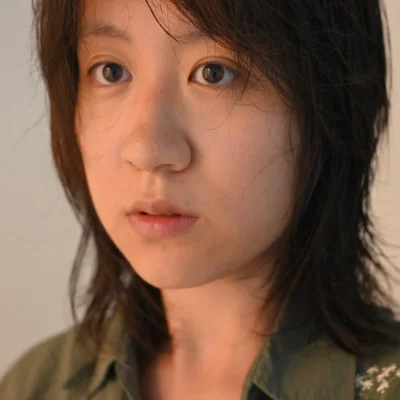
Xinyi Zhang
心怡Xinyi is a community-taught artist born in China. She spent several years in Chicago for study and work, and recently returned to New Zealand, where she is currently based in Auckland. Xinyi’s current ceramic work is mostly focused on small everyday objects that bring up memories of childhood and nature. She is primarily engaged with handbuilding and often transforms thrown pieces further by hand. In her practice, she values play, exploration, and a sense of freedom in the making process, allowing the work to bring out the qi (energy) that moves in line with natural rhythms. The other side of her work involves clay sculptures that ask philosophical questions around permanence and impermanence. She studied at the woodfired pottery school in New Lynn, Auckland, where she created open-formed vessels using local clay and left them unfired so they could reintegrate into nature over time. After that, she made a clay shoebox containing a found shoe and returned it to Long Bay Regional Park to weather naturally. Through these projects, she explores how seemingly contradictory concepts can coexist-clay returns to nature and becomes a permanent part of the landscape, while the traces of labor and human touch gradually disappear. And she would continue this exploration in her residency at Driving Creek this coming November. Xinyi previously worked more extensively with still-life photography, and she was admitted to the MFA in Studio Art at the School of Art Institute of Chicago with a New Artist Society Scholarship in 2025. Now she uses photography primarily as a way of documenting and interacting with her ceramic and clay pieces.
Practitioner: 心怡 / Xinyi Zhang
Location: Tāmaki Makaurau
Discipline: Visual Art / Photography / Ceramics
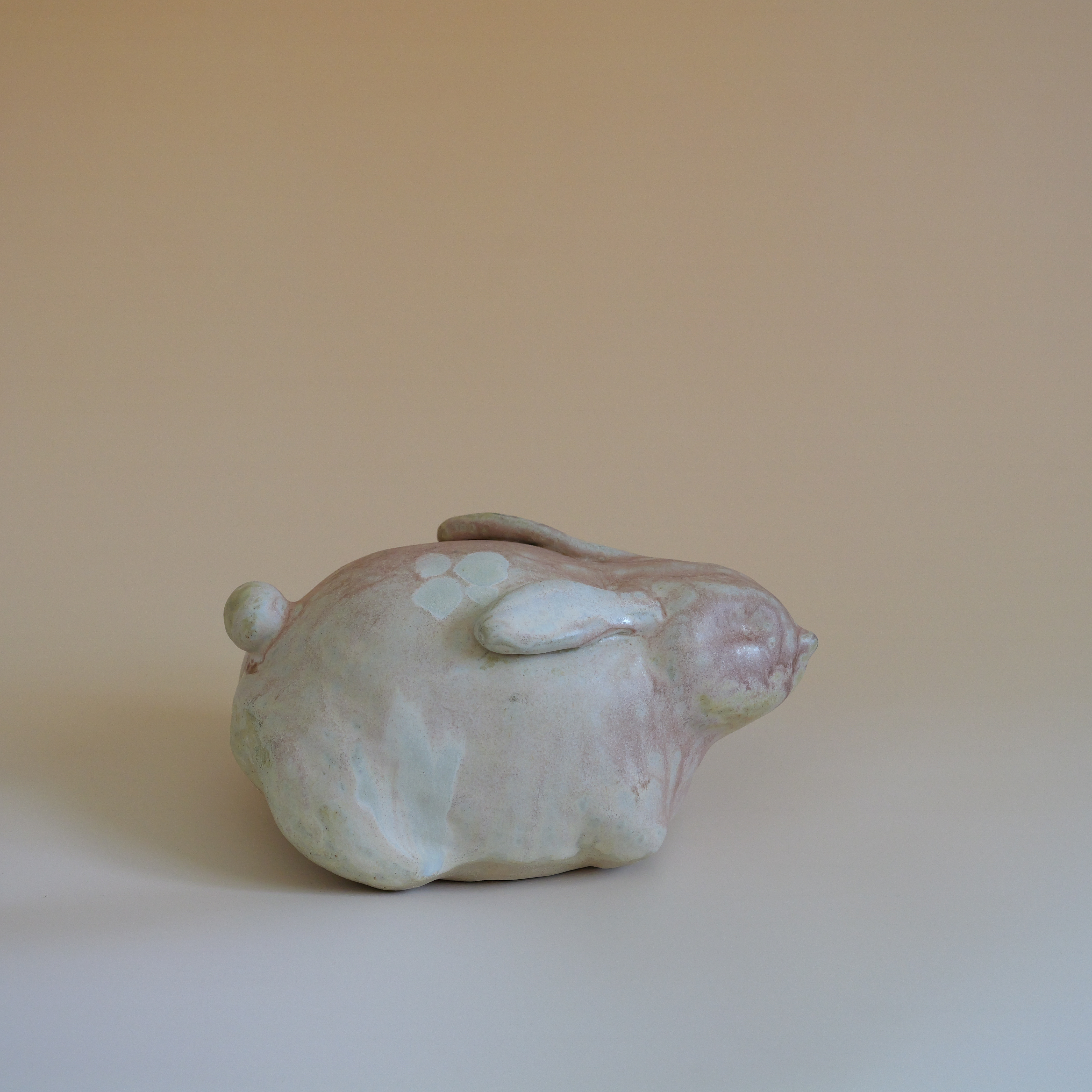
Xinyi came to Patronage, I believe, through Arts Makers Aotearoa, a mailing list feature that sent a handful of new practitioners our way. When her work appeared on the dashboard, I stopped scrolling. Subtle, milky ceramics. Objects that seemed to hold light rather than reflect it. I am no expert in ceramics, but the quality was immediately arresting: soft hues of rose, sage, and slate sitting just beneath the surface, the glaze carrying an almost translucent quality, not literally, but visually. Solid and dissolving at once.
What compounds the impact is that Xinyi photographs her own work. Her photography background, previously still-life and figurative, belongs in high-brow editorial. The result is a rare pairing: you rarely encounter an object of this quality documented with this level of intention. It raises a genuine question: is this a ceramicist with an exceptional eye for documentation, or a photographer rendering objects of her own making? The answer, of course, is both. But the question itself says something.
Her earlier photographic series gesture toward the concerns that would later define the ceramic work. Lived and Loved Before Sunrise presents iris orientalis in two registers: stark botanical compositions against black, and the same subject behind a milky, translucent screen. One negates depth. The other celebrates it while obscuring the subject. After Faith portraits a figure lying on a couch, simply upside down. Depthless, directionless. Both series anticipate the ceramic work's preoccupation with presence and solubility: the idea of something you can almost see clearly, the way a memory exists vividly in concept but blurs at the edges when you reach for the detail.
The ceramics themselves are vessels of memory, quite literally. Rabbits, wish boxes, found shoes. Objects that carry personal associations for Xinyi but open outward to the viewer's own archive. Her description of Horse Year Wish Box, "write down your wishes and/or select certain relevant small items and put them in the wish box for them to take roots and come into reality," reads, alongside her own biography, as objects forming from intuition, subconscious accumulation, and the logic of manifestation. Not just wishing forward, but the way ideas subside into the void and resurface later, returning to life through earth and water.
Her bio describes the project's central tension precisely: the clay returns to nature as a permanent part of it, but the labour on the clay is no longer visible. The earth re-absorbs the work. What remains is the form, and the memory the form carries. It is extremely elemental, and the milky, near-translucent quality of the recent ceramics could not be a more fitting material expression of that idea.
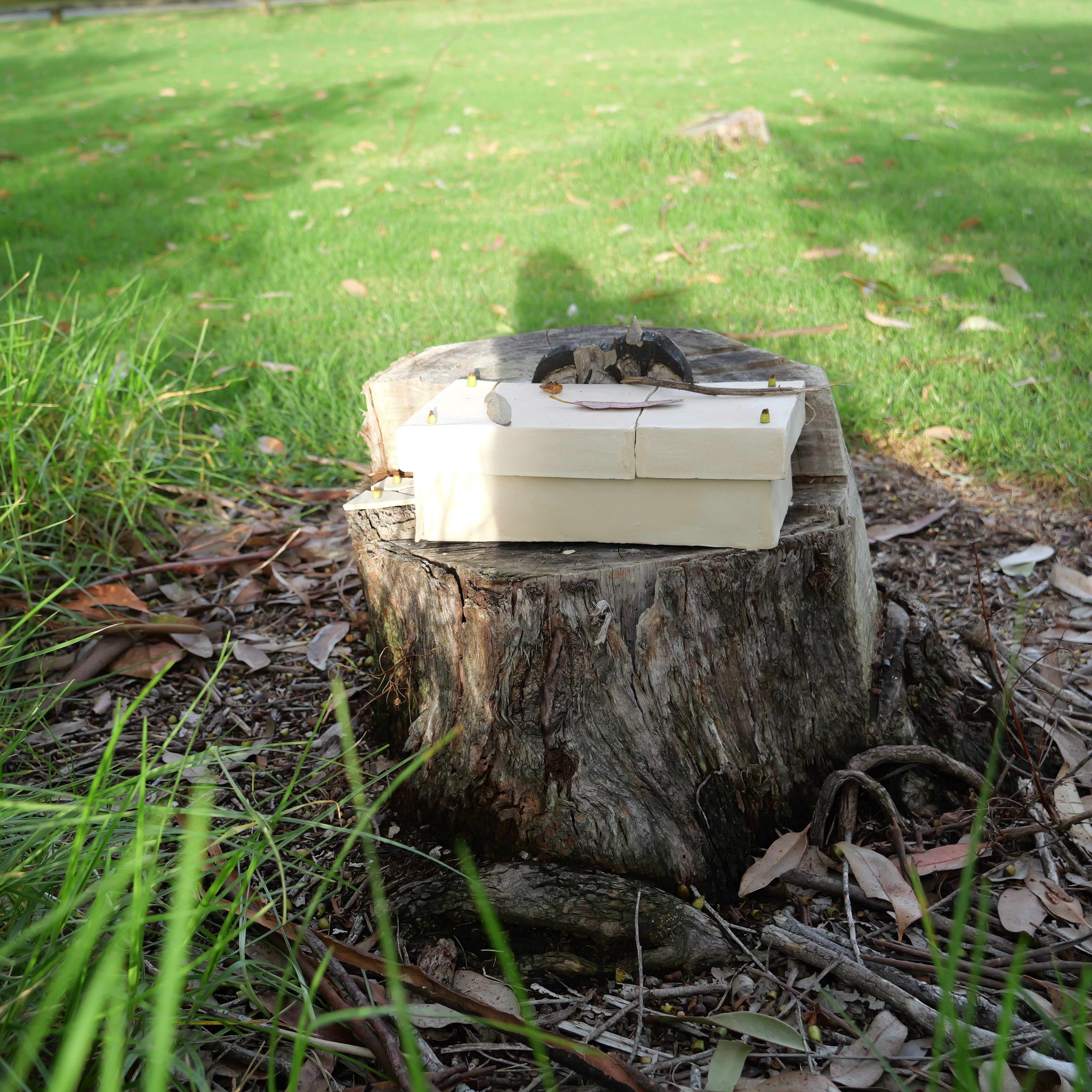
Untitled (clay and a found shoe) looks like a departure, but the logic holds. Clay from the earth. A shoe that belonged to someone. Xinyi formed a vessel from unfired clay, placed the found shoe inside, and left the work on a tree stump at Long Bay Regional Park. The elements did the rest. Rain returned the clay to the ground, nutrients back to root and earth, while the leather shoe remained, revealed. It is a quietly poetic cycle: a raw rethinking of art as object, of commerciality, of permanence in time. I would not have thought to leave ceramics in public, so fragile and so exposed. But it proved the point precisely because of that fragility. I look forward to seeing where this takes her.
Selected Works:
Unearthed Childhood (2026). Ceramics. 15 × 8 × 8cm
Untitled (2026). Clay and a found shoe. 30 × 8 × 10cm