
How arts funding works in Aotearoa: the numbers behind Creative New Zealand grants
20 May 2026
Featured artist
Blake Aitken
I’m an artist and creative strategist working across art, architecture and the built environment. I work with developers, organisations and communities to identify where creative work can contribute to a place, then help bring those ideas into the world through artists, commissions and creative programmes. I’m also building Patronage, a platform connecting artists with funding, commissions and the people who support their work.
Two Creative New Zealand applications. Both declined.
I started looking more closely at how funding actually moves through the arts ecosystem in Aotearoa.
This round I applied for two projects.
The first was a Creative Fellowship to develop ethical safeguarding frameworks for working with people experiencing homelessness in public art. Consent protocols, withdrawal rights, aftercare, participant control over likeness and story, fair remuneration, and partner-led safeguarding developed alongside frontline organisations. The kind of groundwork that should exist before anyone puts vulnerable people into a public artwork.
The second was Cost of Passage / Utu o te Haerenga. Karangahape Road Business Association commissioned the work through an EOI. Auckland Transport approved and supported installation, allowing the work to attach to existing signposts along K Road. The project connects nine underserved, often under-recognised charities through a network of nine street-mounted donation bowls placed into everyday pedestrian flow. Leave a coin, take a coin. QR codes link to each charity.
Both applications were unsuccessful.
That is part of the process. What interested me more was the structure around it.
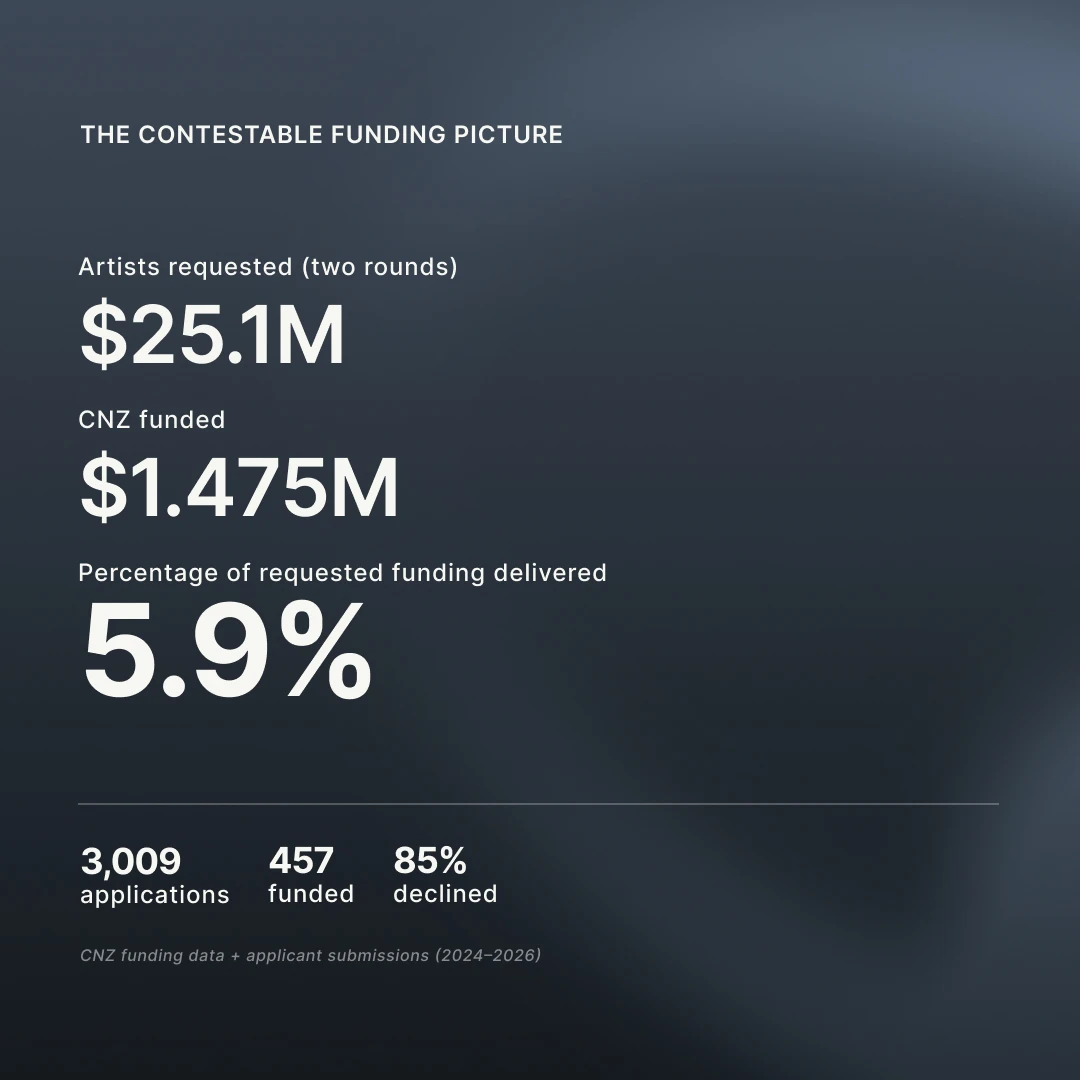
Across my two rounds, 656 applications requested $25.1 million. CNZ funded $1.475 million. That is 5.9% of what was asked for.
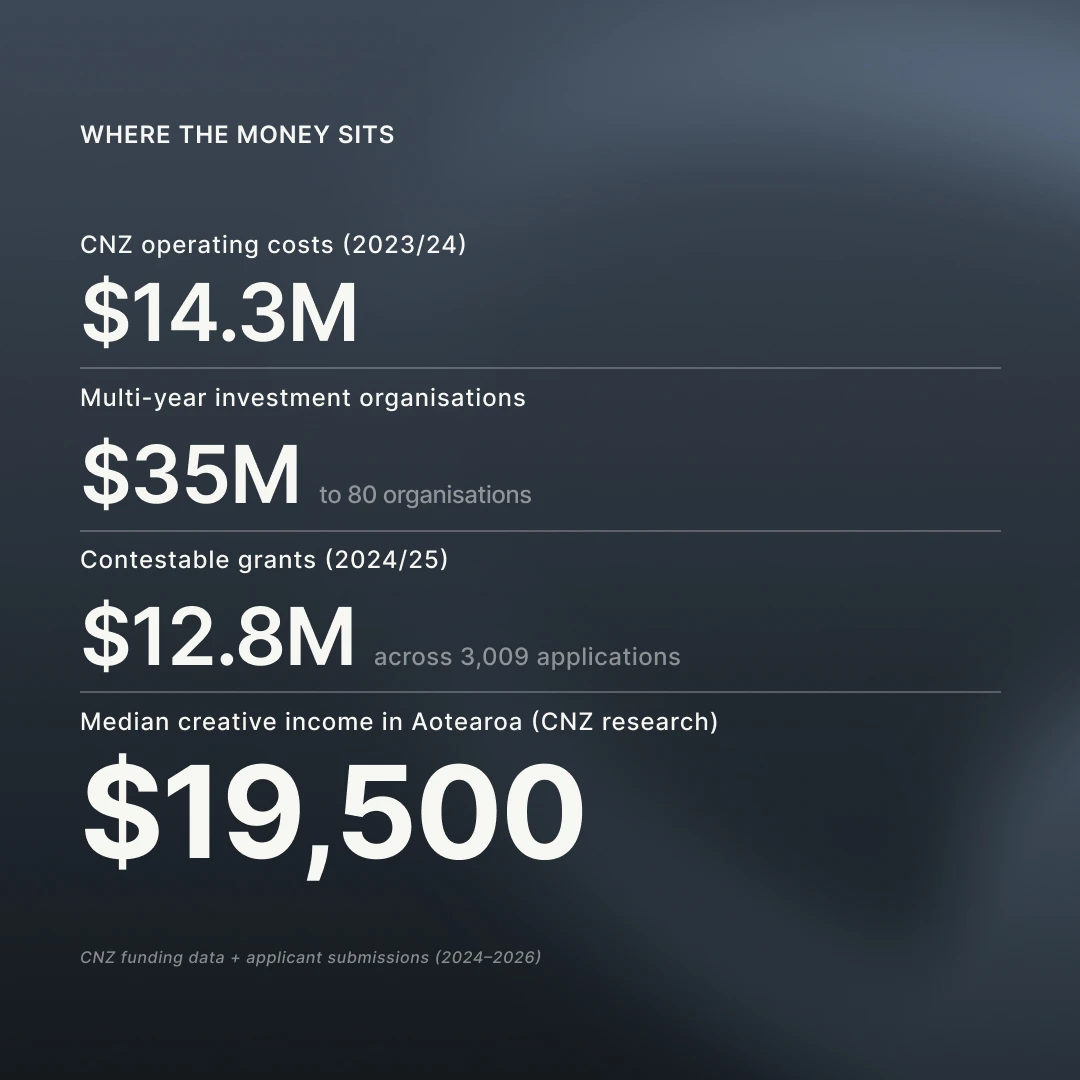
Across all CNZ contestable grants in 2024/25, 3,009 applications were submitted. 457 projects were funded. 85% of applicants received nothing. During the same period, the contestable funding pool dropped from $26.6 million to $12.8 million.
CNZ's own research places the median creative income in Aotearoa at $19,500.
At the institutional level, funding looks different. Approximately $35 million goes annually to 80 multi-year investment programme organisations. CNZ operating costs in 2023/24 were approximately $14.3 million, including around $10.4 million in personnel costs across 82 staff.
Many of these organisations do important work and provide continuity, venues, advocacy, education, and public programming across the sector. I am not questioning their value.
At the same time, long-term public investment raises questions about balance across the system. CNZ reporting shows that 88% of investment programme organisations met financial health expectations in 2024/25, down from 90% the year before. The proportion of non-CNZ revenue across those organisations barely clears 67%. After years of sustained investment, the reliance on CNZ funding remains high.
There is also movement. CNZ's Tū Mai Rā strategy and the shift toward regional decision-making signals a decentralising direction that may open new pathways between artists, infrastructure, and public space. That is worth acknowledging.
The question is how the system supports both continuity and new work at scale.
The amount of unpaid labour required to become "fundable" is now substantial. Before submitting these applications, I had already secured permissions from Auckland Transport, confirmed nine charity partners, started co-developing safeguarding systems, coordinated stakeholders across agencies, produced documentation and proposals, prototyped delivery models, designed public participation frameworks, and built project infrastructure and communications.
All before receiving any funding. All required to be competitive.
This is not about intent. The people inside these organisations care about artists. It reflects a funding architecture designed in a different era, now sitting alongside practices that span public space, technology, social systems, participation, and civic infrastructure. Many contemporary practices fall between categories while requiring significant upfront development before they are even eligible to compete for support.
My projects will continue regardless. The safeguarding framework will still be developed. Cost of Passage will still be built.
What I increasingly believe is that sustainable creative careers in Aotearoa will require more pathways alongside contestable funding.
That includes stronger commissioning models, embedded civic arts budgets, partnerships with existing infrastructure, and systems that connect artists directly to spaces, surfaces, organisations, and communities already operating in the city.
One model already exists. Hamilton City Council has implemented a 1% for arts policy, where up to 1% of capital project budgets is allocated to public art. It is not a separate contestable fund. It is built into the plumbing of how the city builds and renews itself. Roads, pipes, buildings, public spaces all carry a creative line item. This shifts art from something applied for to something embedded.
Other councils could follow. Central government infrastructure spending could carry a similar percentage. Artists could be contributors to transport planning, housing developments, and civic renewal not through grant applications, but through standing commissioning budgets that already exist inside the systems shaping our cities.
Imagine a 1% arts line in every public infrastructure budget. That alone would dwarf the current contestable pool and remove the enormous upfront gamble artists currently carry just to be considered.
The work is already being done. The partnerships, the permissions, the frameworks. Artists are building them now, often unpaid, often invisible.
The question is whether the funding architecture can catch up. Some cities have already started answering it.