
FEATURE 006: Mariana du Plessis's Geological Maps
18 June 2026

Featured artist
Mariana du Plessis
Multi disiplinary practice BMCA 2025 time - light - people - environment
Practitioner: Mariana du Plessis
Location: Kirikiriroa
Discipline: Painting / Photography / Sculpture
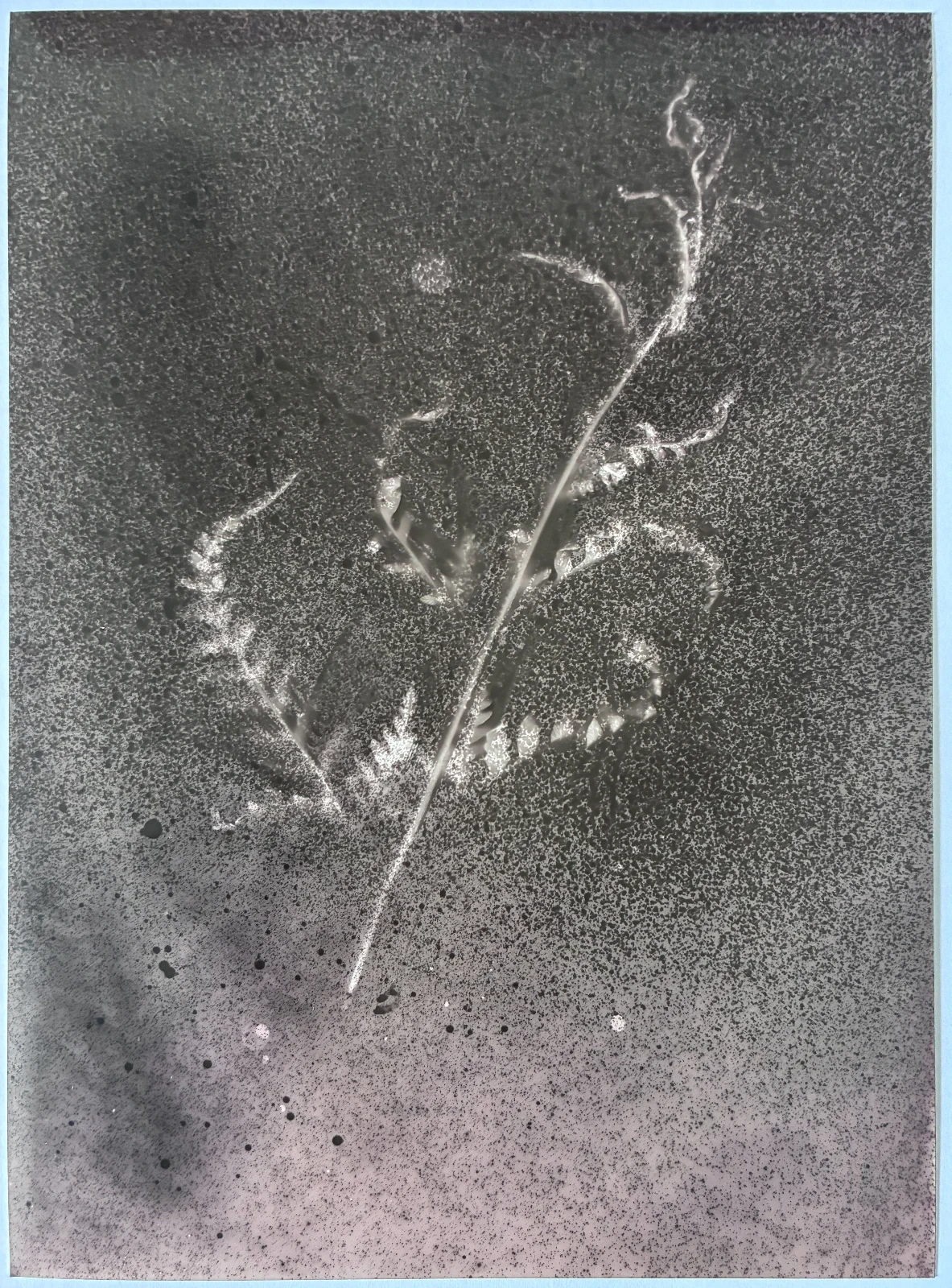
Mariana is the third Wintec practitioner to feature on Patronage, following Max Nasmith and Mr Black. That is not coincidence. It reflects the density of a particular corridor in Kirikiriroa — a school producing artists who think across mediums, work outside the main centres, and carry strong opinions about what institutional support actually looks like. When her work appeared on the dashboard, two things registered immediately: a painter working across mediums who treated each one as a different language for the same conversation, and a lumen print of a fern that stopped me mid-scroll. Not because of what it depicted, but because of what it withheld.
She is currently completing her Honours in Media Arts at Wintec whilst teaching at the Waikato Society of Arts — occupying both sides of art education simultaneously. Her practice spans painting, photography, lumen printing, and sculpture, but she resists treating these as separate disciplines. They are, in her words, different methods of communication, each offering a different perspective on the same broader themes: identity, memory, and the synthesis of internal experience with observed landscape.
Her portfolio resists categorisation not through ambiguity but through fluency. Visual art, photography, craft — she moves between them without the friction that usually accompanies multi-disciplinary claims. Most artists who say they work across mediums are really working in one and dabbling in the rest. Mariana treats each as a distinct language for the same underlying conversation.
Her latest works include Fern (2026), a lumen print — a process where objects are placed directly onto photographic paper and exposed to ultraviolet light. The fern does not sit for a portrait. It leaves an impression. The result is simply beautiful, earmarked entirely by process. But the process itself is more loaded than it first appears. A lumen print is an index of four things: time, light, people, and environment. The exposure duration determines the tonal range. The UV source, whether studio lamp or Waikato sun, writes the climate into the surface. The hand that places the fern decides the composition. And the fern itself is pulled from a specific place, a specific season, a specific walk. The print records all four without narrating any of them.
Mariana is early in her formal exploration of lumen printing and cyanotypes, and that is part of what makes the work interesting. It sits at the exact intersection of her two roles. As an artwork, the lumen print is arresting. As a tool in the hands of an educator, it’s a way of communicating process to students without the burden of technique getting in the way. Place the object. Expose the paper. Trust the result. The concept is difficult to locate in critical terms, but the value is immediate: a demonstration that the act of making can be legible, accessible, and beautiful before it needs to be anything else.
The paintings are where the practice opens up. Acrylic on canvas, though you would be forgiven for assuming oils. Mariana bleeds, blends, and glazes paint into landscapes that do not exist. She pulls these views from memory rather than reference, and the result is something neither she nor I have seen before, yet both of us can attribute to places we have travelled. The paintings feel familiar without being identifiable.
NO (2025) places the word, capitalised, atop an umber plain. Mountain ranges sit behind, softened to the point of atmosphere. I cannot ascertain the context of the word. Whether it is refusal, boundary, protest, or simply a sound the landscape makes. It is arresting precisely because it withholds the explanation. Sorry (2025) operates in the same register but trades the warm palette for bleeding blues. A stunning cliff face, waterfall, and forest scene rendered purely through tonal wash. But it is not rendered to life. The viewer cannot make out any truly distinguishing features. It looks like waterfalls down valleys. It looks like cliffs either side of a river. Forest in the background. But the process, the painting, does not allow for certainty. A small "sorry" finds itself in the upper third, the paint touched so lightly the word is barely there.
They are true surreal, déjà vu landscapes. Like having a dream and only being able to recall the blurry edges of it in the morning. We know this place. It is on the tip of the tongue, but it refuses to identify itself. Mariana describes them as "a malleable geological map of personal experience rather than documentary," and I cannot improve on that phrase. The landscape is only a view when it is being passively observed. Once she paints it, it becomes material.
The mundane is the subject. Plains, valleys, mountain ranges, forest. But it is never reduced to being mundane, because these left-field interjections, "no," "sorry," introduce an uncertainty that the landscape alone does not carry. Without them, the paintings are undeniably beautiful and raw. With them, they become uneasy. The viewer is no longer just looking at a view. They are looking at a view that is trying to say something, or that has had something said to it, and the gap between those two readings is where the work lives.
I think this is what makes Mariana a strong emerging artist and an equally strong educator. Painting a landscape is formally inclusive. It is available to anyone with a brush and a surface. The act itself is not the differentiator. What separates Mariana is the recognition that something can be done to elevate the work beyond the competent, beyond the beautiful, into territory that others might not reach, or might not think to reach. That sensibility, the instinct for when a painting needs a word whispered into it, is not easily taught. But the disposition behind it, the willingness to experiment, to discover, to trust the process past the point of comfort, is exactly what an educator can model. And Mariana is doing both at once.
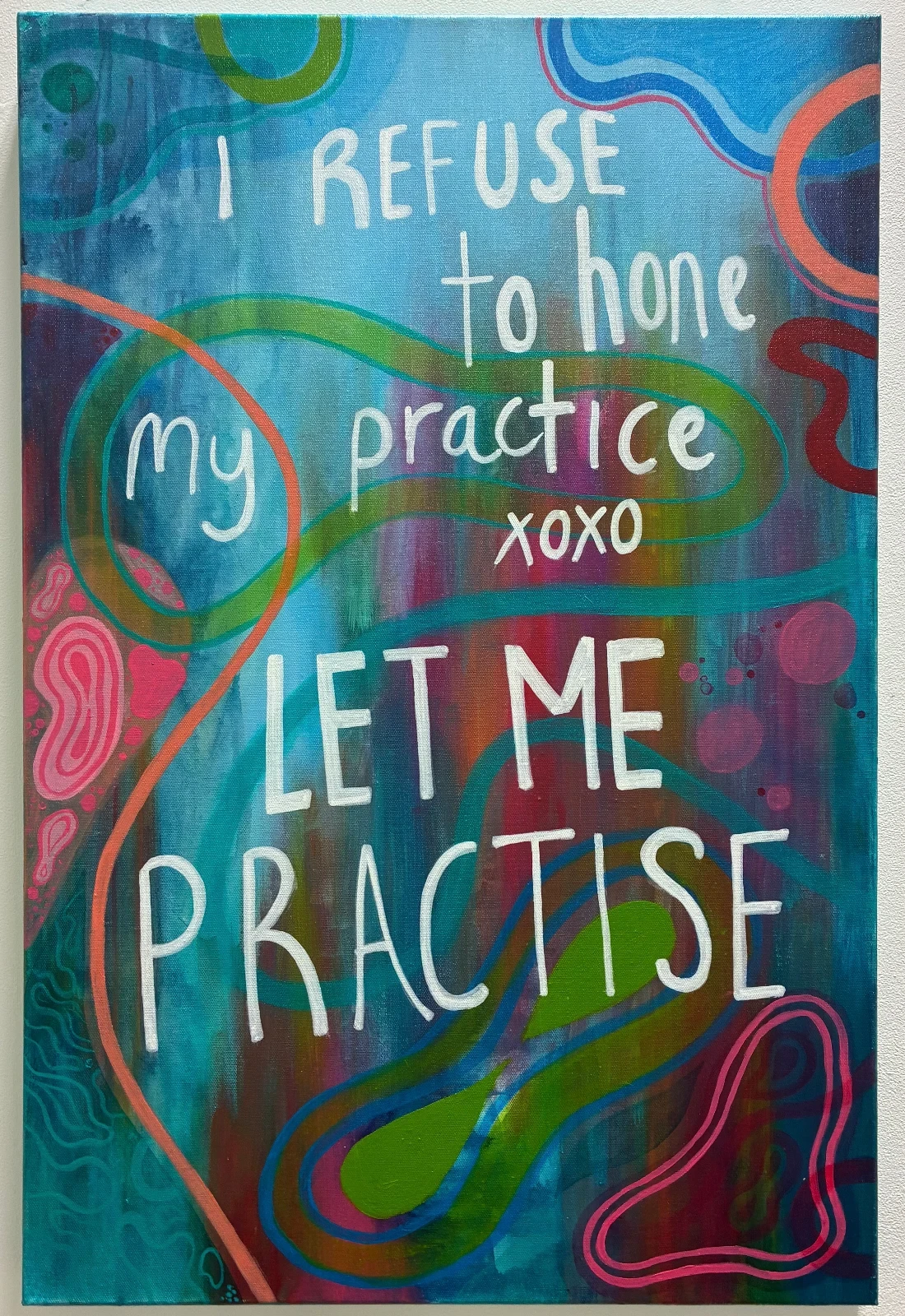
Let me Practise (2025) is the work I would not have chosen for the feature. Formally, it is not my territory. Biomorphic shapes somewhere between SpongeBob and a cell diagram ribbon through a saturated field of teals, pinks, and greens. It is loud. It is unrefined. It looks like it was made fast and meant to feel that way.
But Mariana has forced me to look at it, and she is right to.
The inscription reads: "I refuse to hone my practice xoxo LET ME PRACTISE." It is a painting that talks back. Not to itself, not to the tradition it sits within, but directly to whoever is standing in front of it with an opinion. The "xoxo" is the detail that makes it work. It softens the refusal just enough to make it irreversible. Not aggression, but a boundary delivered with a kiss.
It is the ugly duckling of her portfolio, and it knows it. That self-awareness is the point. The painting does not ask to be liked. It asks to be left alone long enough to become whatever it is becoming. In a way, it is the most honest statement an emerging artist can make: go and try painting something yourself before you tell me what mine should look like. And the fact that it sits alongside work as considered as Fern and as atmospheric as Sorry suggests Mariana knows exactly what she is doing. She just refuses to be told when she is done learning how to do it.
Selected Works:
Fern (2026). Lumen print. 8 × 10 inches.
Let me Practise (2025). Acrylic on canvas. 600 × 800mm.