
Aotearoa's Regional Arts Infrastructure and the Question of Measurement
28 June 2026

Featured artist
Blake Aitken
I’m an artist and creative strategist working across art, architecture and the built environment. I work with developers, organisations and communities to identify where creative work can contribute to a place, then help bring those ideas into the world through artists, commissions and creative programmes. I’m also building Patronage, a platform connecting artists with funding, commissions and the people who support their work.
Creative New Zealand is simultaneously devolving up to $40 million in funding decisions to regional partners and cutting a third of its workforce. Both were confirmed by CEO Gretchen La Roche in June 2026. The Government's Amplify strategy wants to grow the creative sector to $22 billion in GDP by 2030. CNZ's own Tū Mai Rā strategy envisions "thriving artists, ringatoi and practitioners, with viable creative careers, supported by a strong arts infrastructure."
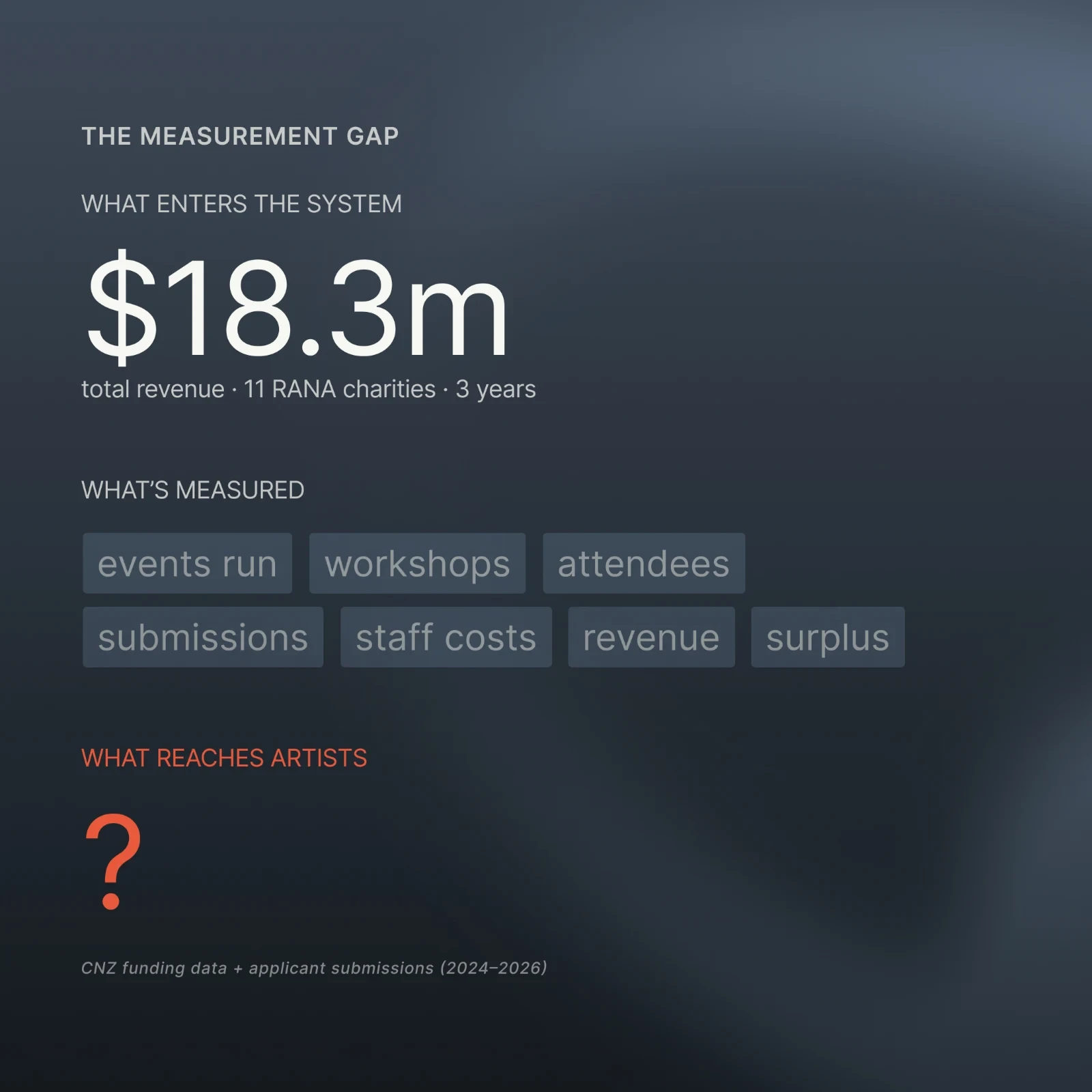
The system can tell us how much money enters arts infrastructure. It cannot tell us how much reaches artists.
I went through the Charities Services annual returns for every registered charity in the Regional Arts Network of Aotearoa, the organisations most likely to become CNZ's regional partners. The data covers three financial years across 11 organisations and 33 annual returns. The most important finding isn't about money, it's about measurement.
What Is at Stake
The devolution is proceeding under conditions that make the absence of baseline metrics especially consequential.
CNZ has announced plans to cut 23 jobs, primarily the arts practice advisers who work directly with artists, reducing that team from 26 to eight, according to the Public Service Association. "These are not back-office jobs," PSA national secretary Fleur Fitzsimons told The Post. "These are people with deep expertise and genuine relationships in the sector, who work alongside artists and arts organisations every day."
As Claire Mabey reported for The Spinoff, all existing multi-year contracts with arts organisations wind up by December 2026, and CNZ is seeking one partner in each of 16 delivery locations. Mark Amery's reporting for The Big Idea identified significant geographic gaps: no RANA member organisations across large parts of the central and lower North Island, and the entire east coast of the South Island outside Ōtautahi. Fitzsimons noted that CNZ itself has admitted it "does not know if there are enough regional partners capable of taking on the task." La Roche confirmed to Amery that the change comes with no additional funding.
Fewer CNZ staff, no new money, unequal partner capacity, geographic gaps, and no baseline metric for the outcome being promised.
What the Data Shows
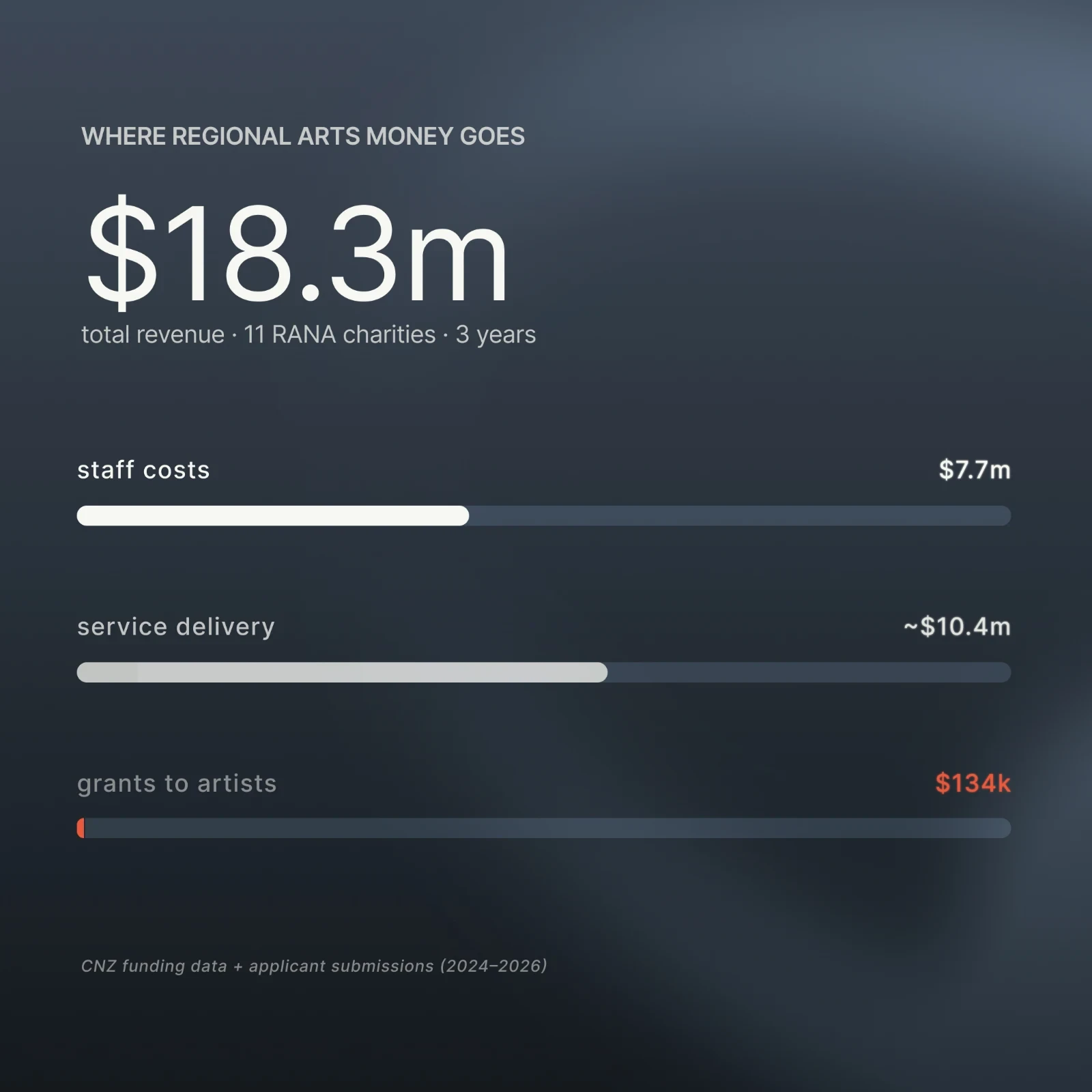
Across FY2023–FY2025, the 11 RANA member charities received $18.3 million in combined revenue. They spent $18.2 million. Staff costs accounted for $7.7 million, or 42.5 percent of total expenditure. Whether that proportion is reasonable depends on what the remaining spend produces for practitioners. The reporting framework does not answer that.
Recorded artist-grant distribution (a narrow but directly comparable category) totalled $134,377 across the entire network over three years. That's 0.74 percent of expenditure. Seven of the eleven organisations, including the two largest, made zero grants to artists in all three years.
These organisations are not grantmakers. They are registered for advocacy and capability building. Their charitable purposes say so. Their annual returns confirm their main activity as "provides advice / information / advocacy." Nobody set them up to be granting bodies.
So the grants figure is not evidence of failure. It is a signal: formal redistribution to practitioners is minimal. The question is whether practitioner income flows through other channels, and whether anyone can see it.
A significant portion of RANA spending sits in a line item called "service delivery" (or equivalent), ranging from 25 to 98 percent of expenses. Service delivery almost certainly contains some payments to practitioners. It may contain a lot. But because it is reported as a single aggregate figure, it is not possible to determine what proportion reaches artists versus what proportion sustains the programme itself. An event that pays local musicians and a workshop that pays for a venue and catering both sit in the same line.
The problem goes deeper than aggregation. The reporting categories themselves are inconsistent across the network. One RANA member reports $0 in employee remuneration and $482,000 in "commercial activity expenses" in the same year it declares staff. These are not signs of dishonesty. They are signs of a reporting framework that was never designed to answer the question: what proportion of this organisation's spend is verifiably practitioner-facing at the point of transaction?
The honest position is: we don't know how much arts infrastructure spending reaches artists. That uncertainty is itself a finding.
The Missing Instrument
Income is not the only value generated by arts infrastructure. Community connection, cultural capability and participation all matter. But income is the only value currently claimed in strategic goals that use terms like "viable careers." If the system makes income-adjacent promises, the system should have income-adjacent metrics.
It does not.
The Charities Services framework does not ask how many artists received paid work. CNZ's reporting does not track how much of its investment can be traced to direct payments to practitioners. Amplify's proposed evidence framework, set out in its implementation plan published by Manatū Taonga, calls for "a best practice model to collect, synthesise and report data related to the creative and cultural sectors" but does not specify practitioner income as a data point. The Profile of Creative Professionals, published by CNZ and NZ On Air in 2022, found the median income from creative work alone is $19,500, less than a third of the national median salary. Public reporting does not currently reveal what proportion of practitioner income flows through the arts infrastructure established to support it.
RANA organisations were established to advocate for the arts: making the case to councils, funders and communities. Over time, many also took on coordination and capability building. These are legitimate functions, but they are measured primarily by activity rather than by structural outcomes. The system records workshops delivered, meetings held and submissions made. It does not ask whether that advocacy resulted in percentage-for-art policies, embedded commissioning roles, standing public art budgets, or other enduring sources of practitioner income.
The devolution model now adds a third function, funding administration, to organisations whose earlier functions have not been measured against practitioner-income outcomes. Funding administration requires assessment panels, conflict-of-interest protocols, artform expertise, and financial controls. Philip Clarke, former Northern Regional Arts Council worker, told Amery that CNZ will need to invest heavily in helping organisations navigate: "Rather than, here's a contract and here's a million dollars."
Some commissioning models demonstrate that practitioner income can be generated through mainstream infrastructure budgets rather than arts grants. Auckland Council's urban development office embeds artist commissions within capital projects. No equivalent function exists in any other region. If advocacy is intended to produce structural change, then structural changes like these should become visible outcomes. At present, they are largely invisible in the reporting framework.
The pipeline gets longer (Crown to CNZ to regional partner to assessment process to artist) without the total pool growing. And the devolution is proceeding without a baseline metric for the outcome it is supposed to improve.
What Should Be Measured
The system currently measures organisational activity: events delivered, workshops run, attendees reached, submissions written. These are inputs. They tell you what the infrastructure is doing, not what it is producing.
A single additional reporting requirement would change the conversation. Every organisation that receives public funding to support artists could be asked to report: what proportion of total expenditure can be traced to direct payments to practicing artists, creatives, curators, performers, writers, designers, technicians, and arts workers?
Not perfectly. Not to the decimal point. But enough to establish a baseline against which claims of "supporting artists" can be tested. Enough to see whether, year on year, the proportion is growing or shrinking.
A minimum viable framework might report: total organisational expenditure; direct practitioner payments (fees, commissions, wages); non-practitioner delivery costs; administration and overhead; number of unique practitioners paid; median payment per practitioner.
Without it, the system measures how much money enters the infrastructure, but not how much passes through to the people the infrastructure exists to serve. It tracks its own activity, not its own impact.
The question isn't whether regional arts organisations should exist. They should. The question is whether the model, existing or proposed, is structurally capable of delivering what both the Government and CNZ say they want. And whether anyone has built the instrument that would tell us.
The data doesn't answer that question definitively. But it reveals that nobody else is asking it either.
This analysis uses publicly available Charities Services annual return summaries (charities.govt.nz) for all registered charitable trusts within the Regional Arts Network of Aotearoa, covering financial years ending between March 2023 and June 2025. The accompanying spreadsheet contains all 33 annual returns in comparative format.
Sources: Amplify: A Creative and Cultural Strategy for New Zealand 2025–2030 (Manatū Taonga, August 2025). Tū Mai Rā, Toi Aotearoa (Creative New Zealand, March 2026). André Chumko, "Creative NZ proposes to cut 23 jobs in 'sweeping' restructure," The Post, June 2026. Mark Amery, "The devolution of Creative New Zealand," The Big Idea, 20 May 2026. Claire Mabey, "CNZ funding is monumentally changing," The Spinoff, 25 May 2026. Kantar Public, "Profile of Creative Professionals," CNZ and NZ On Air, November 2022. Rosabel Tan, "Rooted in Practice: A Mapping of Aotearoa New Zealand's Creative Ecosystem," ASEF culture360, April 2026. Cabinet paper: Amplify proactive release (confirms phases one and two within existing baselines).