
Who Got Funded in Aotearoa: Inside Creative New Zealand Grants 2026
24 May 2026
Written by
Blake Aitken
I’m an artist working across public interventions and cultural infrastructure. I’m currently building Patronage to help artists find funding, share their work, and connect with the people who support it.
Who Gets Funded
Contestable arts funding in Aotearoa has become too scarce to function as broad sector support. The pool has halved. The odds sit below 6%. And the funding that remains flows disproportionately toward artists who are already institutionally legible, geographically concentrated, and in several cases commercially established.
It’s about architecture, rather than corruption or bad faith. At a 6% success rate, contestable funding functions less as developmental infrastructure for the wider sector and more as symbolic recognition of established practice.
On 20 May 2026, Creative New Zealand published results for two contestable funding rounds. I went through the data.
The Odds
At the macro level, 656 applications were submitted across both the Creative Fellowship and Creative Impact Funds. Out of $25.1 million requested, only $1.475 million was distributed.
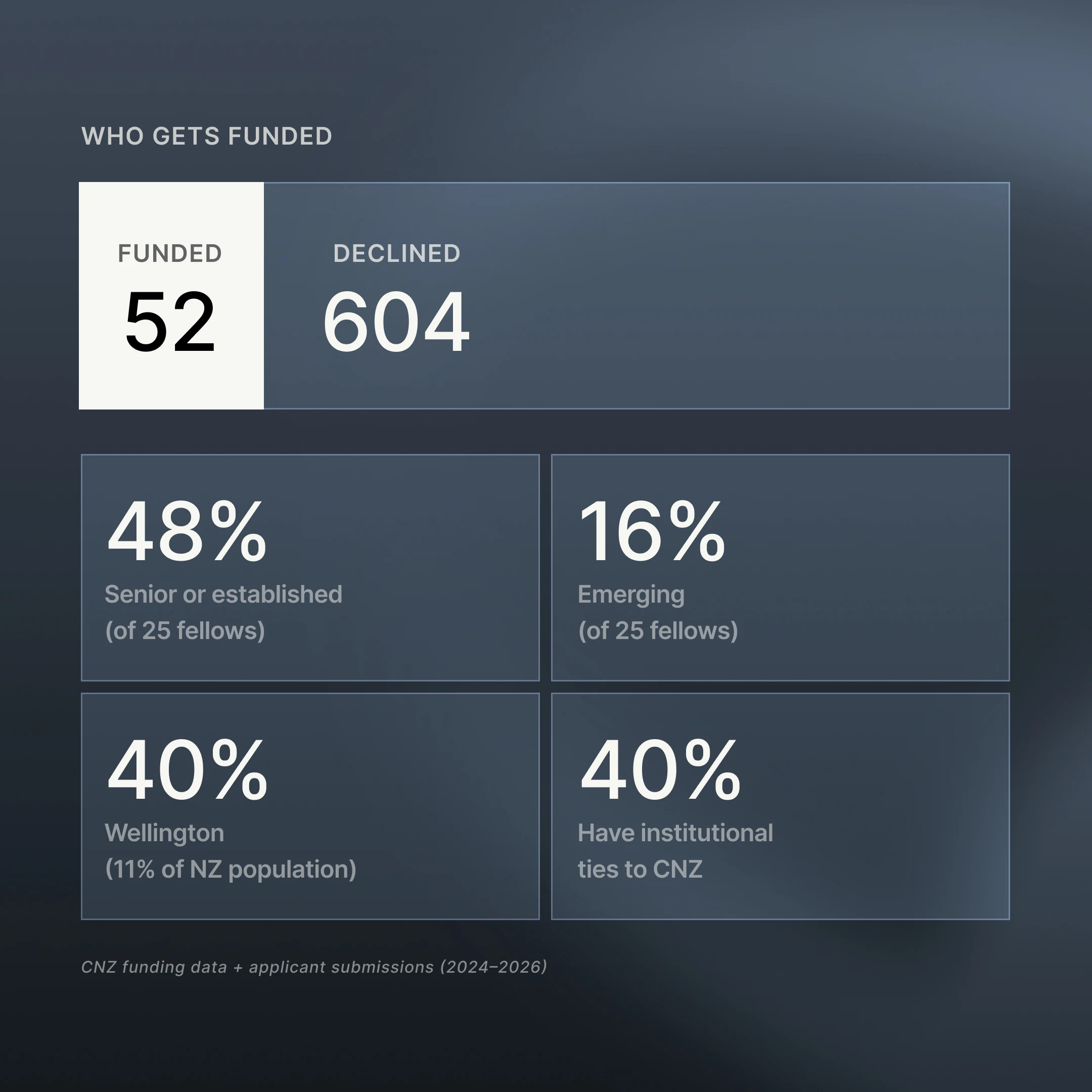
This means that just 52 grants were funded, leaving 604 artists with nothing - a system returning 5.9 cents for every dollar asked for.
When we zoom into the specific pathways, the bottlenecks become clearer. The Fellowship Fund accounted for 409 of those applications, competing for 25 slots. If you look strictly at individual applicants in the general arts pool, 311 people applied and only 17 were successful. For a standard individual artist entering this pool, the reality was a brutal 5.5% success rate.
The funded cohort shows a consistent pattern.
Of the 17 recipients, 11 are established or senior career stage, and 11 have professional ties to CNZ investment programme organisations, including employment, governance roles, commissioning history, or exhibition through CNZ-funded venues. These categories largely overlap. One emerging furniture maker in Kerikeri, with no prior CNZ connection, was the only general arts fellowship recipient outside both patterns.
The Fellowship Structure
Artists choose between a 6-month fellowship at $25,000 or an 18-month fellowship at $50,000. From the total funding requested, roughly 166 of the 409 applicants chose the longer option. That is 41%.
Only one of the 25 funded recipients received the 18-month fellowship.
The system funded the shorter, cheaper format almost exclusively. Whether that reflects application quality or a preference for spreading limited funds is not visible from the outside.
Legibility
The most consistent pattern across both rounds is institutional proximity.
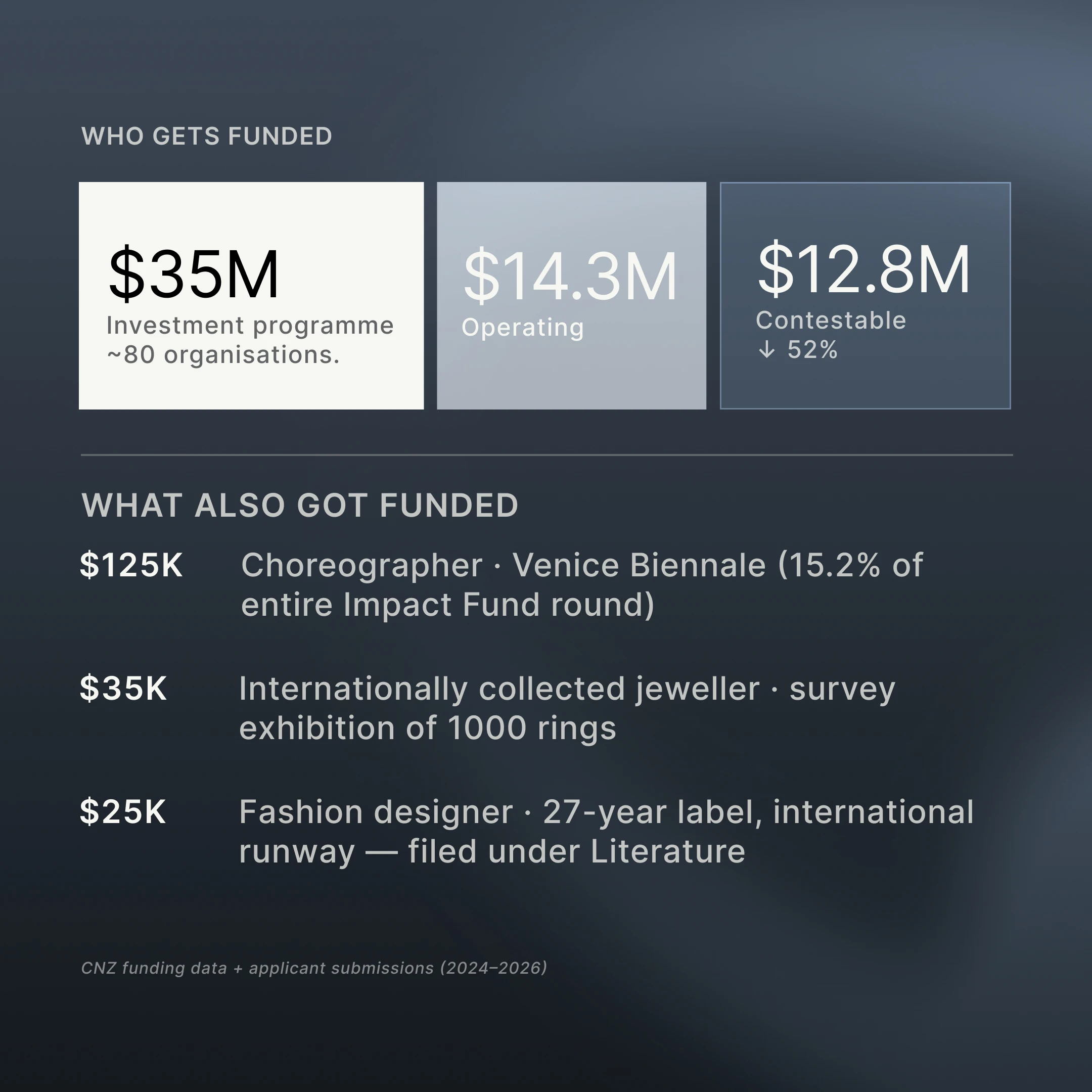
CNZ distributes approximately $35 million annually to around 80 investment programme organisations. Many funded artists are employed by, exhibited through, or have been commissioned by those same organisations.
One recipient is literary editor at a CNZ-funded university press. Another founded an organisation that now receives CNZ investment programme funding and received an individual CNZ grant in the same round. Several have been commissioned by multiple CNZ-funded orchestras, dance companies, and galleries.
This is a classic systems pattern. Assessors working with constrained budgets choose lower-risk applicants. Institutional proximity increases legibility. Established artists have stronger support material. Limited pools intensify conservatism. The result is a system that disproportionately favours applicants already visible within existing institutional networks, not because anyone intends that, but because the architecture selects for it.
Career Stage
The fellowship criteria describe strong applications as supporting "a pivotal moment in an artist's practice" and seek "a spread of results across region, career stage and genre."
48% of fellowship recipients are established or senior. 36% are mid-career. Only 16%, just four out of 25 recipients, are emerging.
Geography
Wellington received 40% of fellowships. Wellington holds approximately 11% of the national population. Auckland, with 34% of the population, received 28%. Combined, 68% of fellowships went to two cities.
The criteria say the assessment sought a spread across region. Wellington's concentration of arts infrastructure likely contributes to this imbalance, but the result still sits noticeably outside national population distribution.
Existing Institutional And Commercial Support
Several funded artists have established revenue streams through gallery representation, institutional employment, international co-production partnerships, or significant prior awards.
One fellowship went to an artist with major dealer gallery representation across three countries and work in international museum collections. Another to a writer who had already received a significant international literary prize and holds a salaried editorial position. Another to a composer based overseas with a doctorate and university faculty position.
In the Impact Fund, $35,000 went toward a survey exhibition by an internationally collected jeweller. $125,000 went to a choreographer who had already secured co-production from five major international venues.
40% of fellowship recipients have identifiable institutional employment, including university positions, broadcasting roles, salaried editorial work, and professional band income. For these recipients, the fellowship supplements existing institutional or commercial income streams. For an emerging carver in Gisborne with no prior CNZ support, the same $25,000 is foundational.
The flat fellowship amount does not distinguish between these situations. The criteria language around urgency and pivotal moments suggests these distinctions are relevant considerations.
The Impact Fund
The Impact Fund criteria describe strong applications as having "increased access to the arts for regional communities." Five of 27 funded projects have clear regional delivery.
At the same time, "diversified revenue streams" is listed as a strength indicator. Many funded applicants already operate within highly diversified professional ecosystems, including gallery representation, institutional employment, and international commissioning networks.
A single grant of $125,000 went to a choreographer who had already secured co-production from five major international venues. That grant represents 15% of the entire Impact Fund round.
This creates a structural ambiguity in the definition of impact. In practice, "impact" spans a wide spectrum, from community-facing delivery and access-based work, to support for established practitioners whose work circulates primarily through existing institutional and international art systems.
19% of funded projects involve travel, residencies, or international festival participation rather than delivery within Aotearoa. $42,663 was allocated to three issues of a specialist visual arts magazine.
All of these outcomes are consistent with the fund’s criteria. That consistency is the point: it shows how broadly defined impact is distributed under contestable selection. As with fellowship selection, the pattern reflects how legibility operates under constrained assessment: established projects translate more easily into ‘impact’ across multiple valid interpretations of the criteria.
Audience
CNZ's purpose statement is to "encourage, promote and support the arts in New Zealand for the benefit of all New Zealanders."
The range of funded projects spans broad public delivery through to highly specialised practice. When 92% of applicants are declined, the balance between these is worth examining against the purpose statement.
Funding Pools
The general arts pool carried 490 applicants across both rounds. 38 were funded. Dollar approval rate: 5.5%.
115 Maori artists applied through Nga toi Maori. 10 were funded. 105 received nothing. At least six funded Maori artists applied through the general pool instead, raising questions about whether the Nga toi Maori category captures the full range of Maori creative practice.
51 Pacific artists applied. 4 were funded. 47 received nothing.
Artform Boundaries
One fellowship went to a fashion designer with an established label and international runway history, funded under Literature. Another went to an arts broadcaster and public art panellist, also funded under Literature. An Impact Fund grant of $42,663 funded three issues of a visual arts magazine, categorised as Visual arts.
Where the artform lines sit matters when 94% of applicants in any given category receive nothing.
The Cost Of The System
CNZ operating costs in 2023/24 were approximately $14.3 million, including around $10.4 million in personnel costs across 82 staff. The contestable funding pool in 2024/25 was $12.8 million.
Operating expenditure supports the full range of CNZ activity, including the $35 million investment programme, international partnerships, capability building, and policy work. But contestable funding has shrunk to the point where the administrative apparatus is now of a similar order of magnitude to direct contestable artist support.
The investment programme ($35 million to approximately 80 organisations) has remained stable. Contestable funding roughly halved in a single year. The pathway available to individual artists is now 2.7 times smaller than the institutional allocation.
What The Data Shows
Many of these recipients are doing important work. The state care work, the customary arts fellowships, the children's theatre tour, the first book on hangi art, the South Asian writing anthology. These fill real gaps.
The people inside CNZ care about artists. The assessors are working within a constrained system.
The patterns are structural. When 92% of applicants receive nothing, and the funded cohort is disproportionately established, Wellington-based, and institutionally connected, the architecture is selecting for proximity and legibility rather than need.
The question is not whether CNZ should exist. The question is whether contestable funding should remain the primary pathway for individual artists when the model may no longer be structurally fit for purpose.
What Else
Contestable systems reward grant-writing capacity. Embedded commissioning systems reward public delivery.
More pathways are needed alongside contestable funding. Embedded civic arts budgets. Standing commissioning models. Partnerships with infrastructure that already exists. Systems that connect artists to spaces and communities without requiring a 6% lottery.
Hamilton City Council has implemented a 1% for arts policy, where up to 1% of capital project budgets is allocated to public art. That shifts art from something applied for to something embedded. Other councils could follow. Central government infrastructure spending could carry a similar percentage.
Compiled using publicly available information including CNZ published results, gallery websites, arts organisation profiles, and artist CVs. Some prior funding information may be incomplete as CNZ does not maintain a publicly searchable database of historical grants by recipient.