
FEATURE 007: Fletcher McClelland's Landscapes After Us
2 July 2026
Featured artist
Fletcher McClelland
Photographic artist with an interest in analogue photographic processes, using film and camera-less photography as a medium to explore and develop interests.
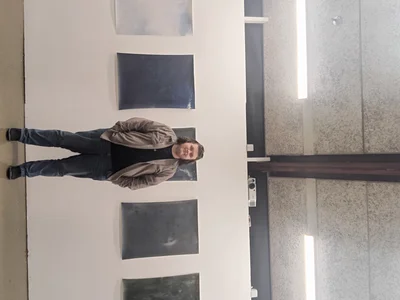
Fletcher is an artist from Ōtautahi, Christchurch, currently studying Fine Arts majoring in Photography at the University of Canterbury. His practice moves between film and camera-less photography, extending into photobooks and exhibitions. His current project explores how a site's foundational infrastructure corrupts the natural environment it depends on.
Fletcher is our first artist to arrive through an institution rather than a person. Ilam's administration staff had been sending Patronage around to students, and Fletcher was the first to follow it through.
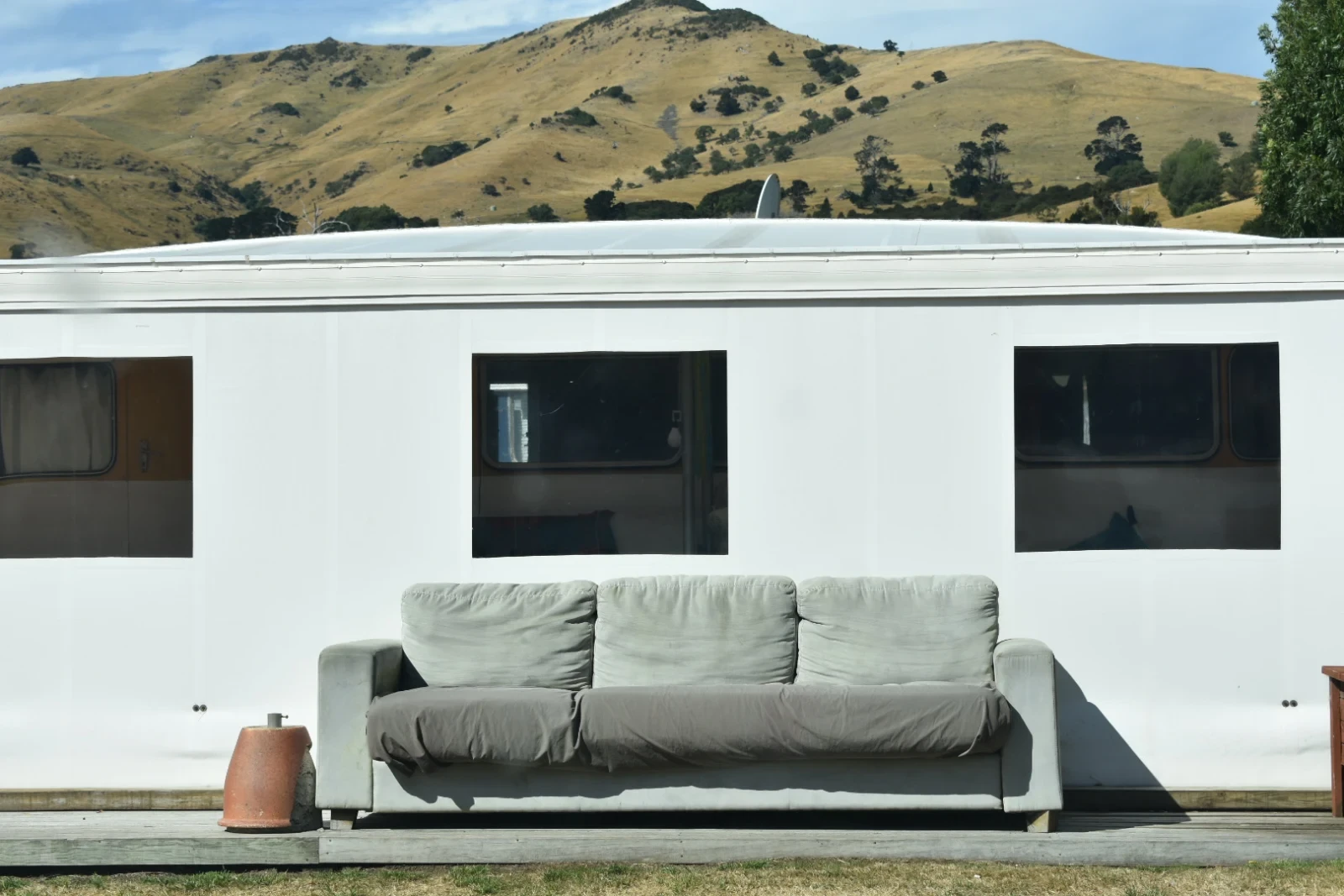
Couch by the Windows (2024) is, for me, still his most engaging image. A three-seater sits abandoned in front of a caravan, or something like one, a not-quite-permanent bach of the kind found at holiday spots the length of the country. The mountain behind it does the heavy lifting, but the composition is the real inheritance: a humble structure, dwarfed by landscape, in the tradition that runs through Rita Angus and Grahame Sydney, sheds and baches set against something far larger than themselves. Fletcher gives it a southern, contemporary twist. The couch itself wouldn't look out of place outside a Castle Street flat. This isn't quite the beach-holiday bach of the Gen X childhood, locking up the house and heading south for six weeks of nothing. It's something looser, a bach life that's less about being at the beach and more about just being in the country. The image would sit comfortably as a postcard, in a gallery, or in a family photo album, and it's rare that a single frame can hold all three.
That's also where the direct bach-in-landscape lineage ends. What follows shifts into something more eerie, more obscured. Fog, film grain, blur, condensation. These are post-apocalyptic in tone, images that wouldn't look out of place narrating some version of the country's future undoing, and they're genuinely beautiful to sit with despite that. The human presence in the work is less obvious here but still there if you look for it: a murky recording beneath a house's foundations, condensation bleeding down a green window, pink fog swallowing a set of train tracks. It's the same tension as Couch by the Windows, just quieter. Nature held back by the built environment, then slowly reclaiming what's been placed on top of it. There are no people in any of it, and there rarely are anywhere in Fletcher's work. The only human figure that appears is a distorted self-portrait. Without the infrastructure in frame, a rail crossing, a set of traffic lights, road markings, these images could belong to almost any decade. That timelessness feels deliberate.
Paradisiacal (2025), made at Ilam, pushes the same instinct further into abstraction. Nine images of a mountainscape, stitched together and displaced vertically along the horizon line, so the mountain never quite resolves into a single, stable silhouette. It was made before I'd seen it, but it brings to mind Brett Graham's Whangamārino (2025), a wide-format, multi-channel video reworking Aukaha's news footage of the 2024 wetland fires. Both works take documentary source material, a mountain range, a burning wetland, and refuse to let it sit in one frame. Graham spreads the fire across multiple channels until the footage stops reading as news and starts reading as elegy; Fletcher does something similar by fracturing a single horizon into nine displaced fragments, so the mountain feels less observed than remembered, pieced back together slightly wrong. Neither work is really about the event or the place captured. Both are about what happens to a landscape once it's been mediated, repeated, and stretched past the point where it can be looked at directly.
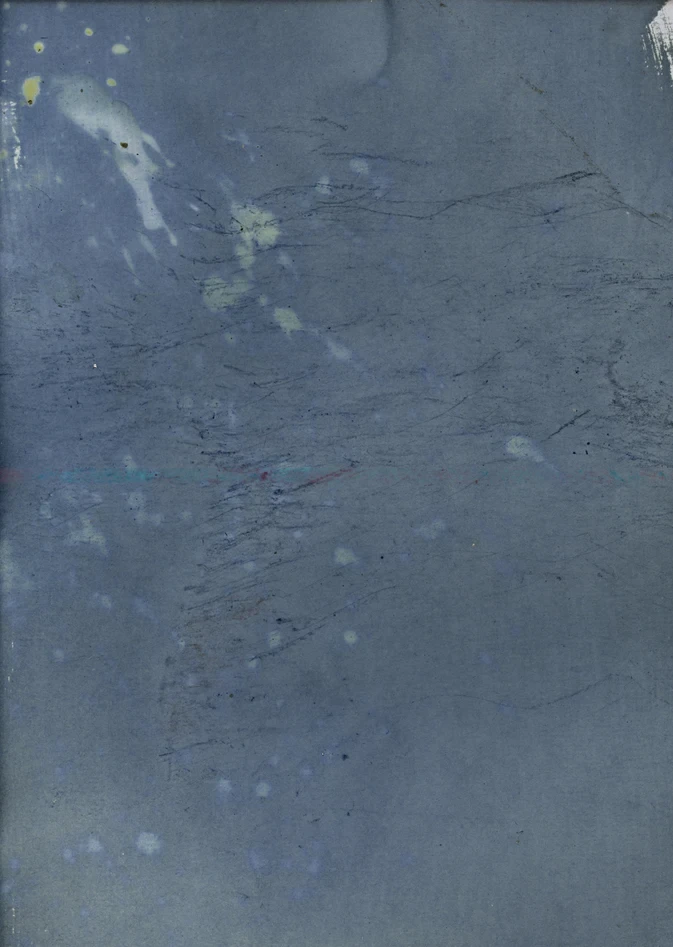
His most recent work, made this year, drops the camera altogether and follows water directly, specifically the effect of infrastructure on it. Where the earlier images treated human impact as something felt at the edges, Landscape Unit #2 and Infrastructure Exposure #1 (2026) expose it outright, in the most literal sense the word allows. Landscape Unit #2 is a ghostly image, water rushing past in long, blurred ripples that blend into one another until the surface stops looking like water and starts looking like static. The file itself is enormous, and that's not incidental. The size comes almost entirely from noise: hot pixels, scratches across the emulsion, the kind of corruption you associate with photographs taken near radioactive sites, film that's recorded more than light.
Looking at it, you find yourself wondering where Fletcher actually was when he made it. Crawling into a stormwater pipe. Crouched under some dingy bridge in the dark. Infrastructure Exposure #1 answers the question without quite meaning to. It's a waterway trench, crossed overhead by a run of pipes, a single shaft of light raying down onto the water below, though whether it's daylight or something artificial is impossible to say. Together the two works do exactly what the title promises: they expose the water itself, and they expose what's sitting directly on top of it.
Selected Works:
Landscape Unit #2 (2026). Photography. 600 × 600mm.
Infrastructure Exposure #1 (2026). Photography. 630 × 870mm.