
FEATURE 004: Xavier Xu's Disciplinary Architecture
28 May 2026

Featured artist
Xavier Xu
I work primarily with installation and moving image. My practice draws from what I observe and experience, exploring the relationship between the body, social structures, and spatial systems. Through duration, repetition, and framing, I examine how environments shape behaviour and perception, revealing the often unnoticed rhythms and controls embedded in everyday life.
Practitioner: Xavier Xu
Location: Tāmaki Makaurau
Discipline: Visual Art / Installation / Moving Image
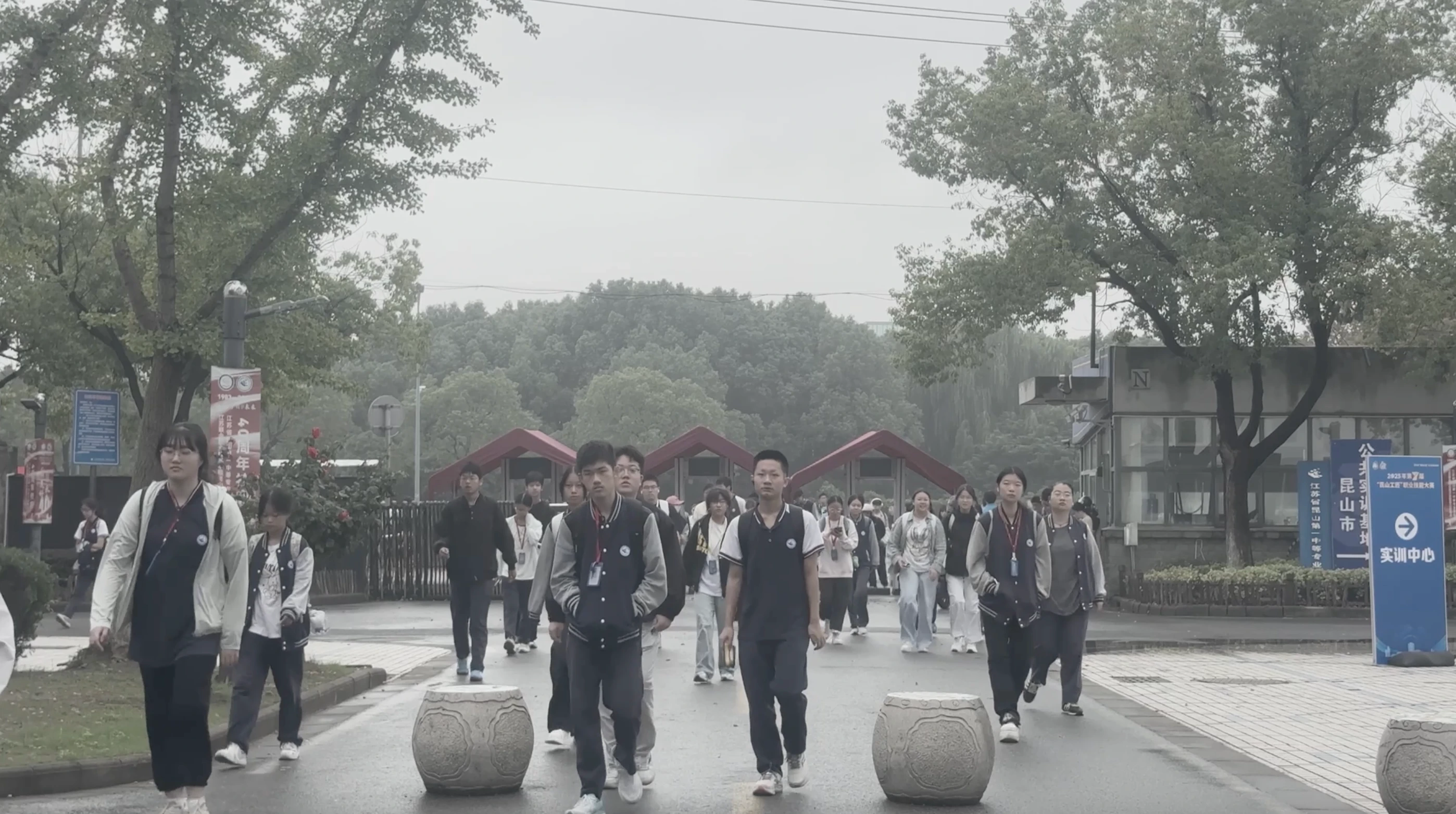
Xavier came to Patronage through manual outreach. In April, I was emailing tertiary art students at Elam, and his profile stopped me. Students Entering the School, Workers Entering the Factory landed immediately. I wrote back saying it reminded me of my own experience after university, not quite fitting the mould of the machine, yet constantly pushed toward traditional working structures. The work is simple, and that simplicity is what makes it powerful.
Two videos, each exactly ten minutes long. Students filing into a school. Workers filing into a factory. Two screens, perched on stands at eye level, positioned roughly 2500mm apart and facing one another. Xavier could have placed them side by side. That would have been the obvious choice. But side-by-side splits the viewer's attention. You get overwhelmed trying to read both at once.
By separating and opposing the screens, Xavier controls the experience completely. Stand perpendicular to the plane and each screen skews into near-illegibility. Stand in the middle, facing neither, and both sit in your periphery, neither in focus. Face one screen directly and the other disappears behind you. The viewer is forced to absorb one at a time, distinctly aware of the screen they are not watching, the one waiting to be seen. It is a spatial argument about control enacted on the body of the spectator, before the content of the films even registers.
The content, when it does register, extends that argument. The two films sit within a long lineage of critique about what schooling actually prepares you for. Not knowledge, not independence, but the workforce. Many have noted historically that the school system does not set you up for life. It sets you up for life in a job. Instead of learning for knowledge, and knowledge as independence and power, we learn to get that job. Instead of being encouraged to start your own venture or simply follow the life you want to lead, a student becomes keenly aware that the entire system runs in the vein of working for someone else. That somehow, employment is the defining rite of passage of being educated.
It extends into tertiary education. As graduates struggle to find consistent, full-time work, it becomes increasingly apparent that a degree is less about learning and more about demonstrating that you can commit fully to a cause. A signal to employers that you can listen, show up, and complete. You get some knowledge, sure, but not enough to go out and start your own thing. You learn just enough to justify that piece of paper on graduation day, and then you get pulled into a job you do not particularly care about in the name of skilling up and getting your foot in the door. Xavier films the entry point of that pipeline from both ends, school and factory, and lets the rhythm speak for itself.
Glass Echo: From the Corners (2025) occupies a different register but follows the same logic. Empty and full glass bottles sit in front of a projection screen. Behind them, close-up footage of glass and light plays in a darkened room, the air filled with an airy, ringing soundscape of friction and collision, a deep resonance sitting beneath. It is not a work you can immediately understand. It is something you have to stand in and absorb.
When I first saw the work, I assumed it was about ritual. The glass bottles as vessels of consumption, but also of communal drinking, whether alcoholic or not. The soundscape supports this reading. It is almost a minimalist rendering of the sounds of celebration: drinks clinking, floors vibrating, the collision of glasses in a cheers. But devoid of human interaction. The presence and the disappearance sit in the same frame without needing much further explanation. What deepened my reading was the relationship to control. Xavier could have simply shown the projection, but instead, he obscures it behind the bottles, curating what the audience sees and hears. Like the students entering the school, like the workers entering the factory, the everyday ritual is right there, but most people never stop to examine the structure around it.
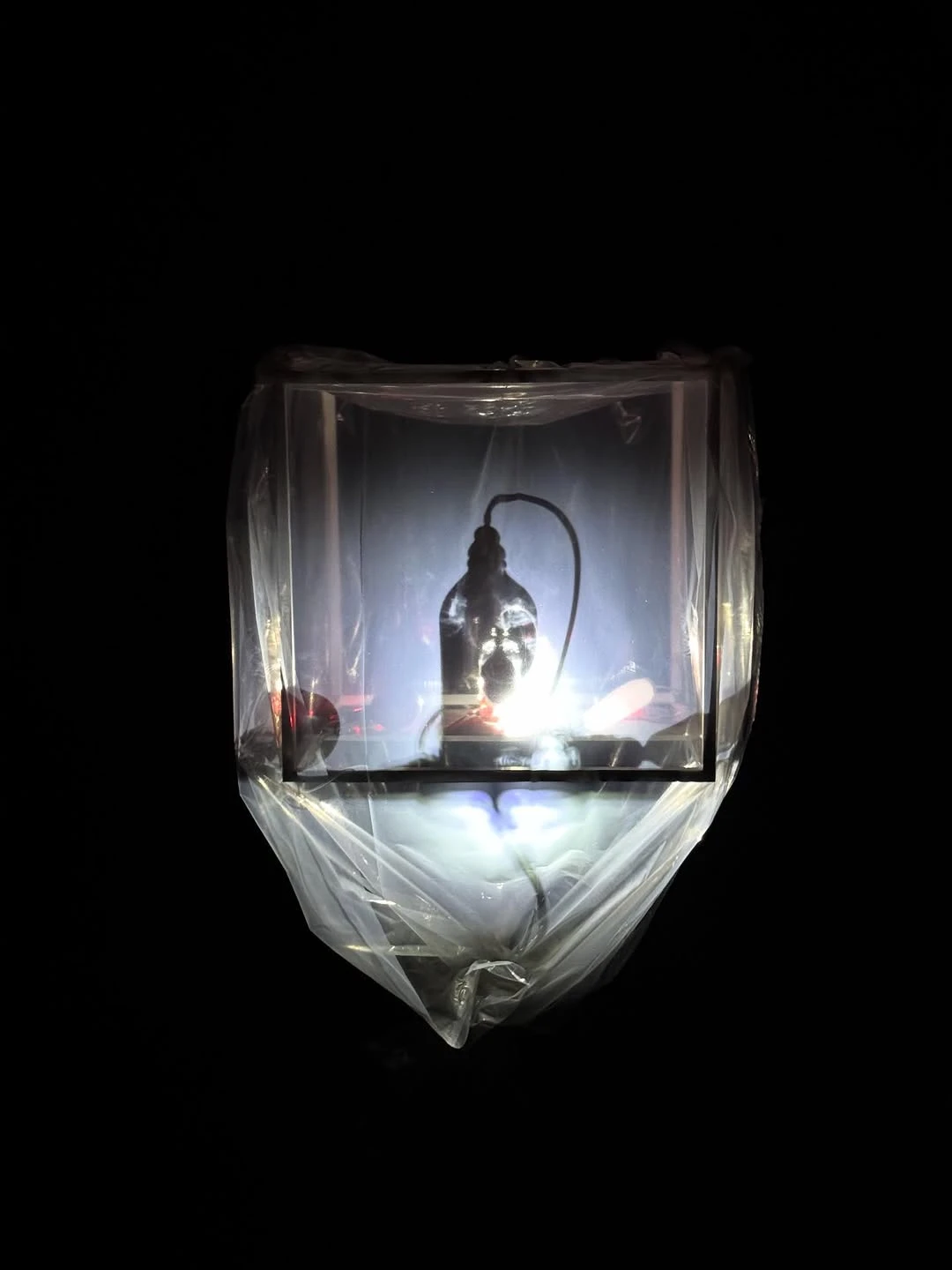
Tension Breath (2025) is perhaps the most intimate of the three. An installation made during a period of intense personal stress while studying abroad. Balloons, a condom, glass bottles. Three states of breathing simulated: numbness, collapse, and suppression. The condom functions simultaneously as lungs and as something closer to an airsickness bag found on an airliner. Almost a homesickness bag. The material choice is interesting. Condoms are constricting, suffocating, and provide a diminished experience, yet are inherently safe. Protective. I do not think anything sexual arises from the work. It is more biological. Breathing exercises to calm oneself, but also the constriction felt whilst studying away from family, and the unfamiliarity of a new country. It is safer to educate at home, but comfort does not produce growth. People learn through discomfort, through the unfamiliar. The simulated lungs, bottle and condom sit within a larger bag. A controlled environment. It is extremely bodily, extremely honest.
Xavier has just graduated from Elam. I am unsure whether he will return home or stay in Aotearoa. I most definitely hope he stays.
Selected Works:
Students Entering the School, Workers Entering the Factory (2025). Dual-channel video installation. 10:00 each.
Glass Echo: From the Corners (2025). Video, sound, glass bottles. Mixed media installation.
Tension Breath (2025). Balloons, condom, glass bottles. Mixed media installation.