
FEATURE 008: Lucas Cantlon's Room Tone
24 July 2026

Featured artist
Lucas Cantlon
Photographer, Producer, Director Studying screen arts @ Massey Univerisity Hosting the Student Radio Network Top 10 @ Radioactive.fm Playing bass for Banjo Ben And The Breeze Taking bookings across NZ Email me! CANTLONLUCAS@GMAIL.COM
Lucas is an Ōtautahi-born, Pōneke-based creative working across documentary, live production, radio, music and photography. They are studying Factual Production in Massey University's Bachelor of Screen Arts, host the SRN Top 10 on Radioactive.fm, and play bass in the folk-comedy band Banjo Ben and the Breeze.
Lucas is Patronage's thirteenth artist, and the first to arrive because of the features themselves. They signed up after Isabella Fuller's went out.
Lucas makes whatever the night requires. Camera operator on one episode of KickstART, floor manager on another, graphics on a third, producer on a fifth. One of five people recording Shuriken's set at Start Today Fest, with the edit handed to someone else entirely. Producer and director on a client film for Create Wellington. Bass player on Cuba Street on a Friday. They're a production house unto themselves, and their exhibition history reads like a crew list, which is the most interesting thing about it.
Lucas has a keen eye for the New Zealand vernacular. An untitled image from May 2025 captures Roger Walker's Link Span Building on the Wellington waterfront at golden hour, long shadows across the tarmac, the projecting window lit up gold, a lone cyclist paused in the mid-ground. It is a photograph taken for the joy of recording a good day out in Wellington, and it is undeniably beautiful, with weather, sun and subject all playing ball. An untitled image from Boxing Day 2025 does much less and lands in the same place: three Westeel grain silos standing in a paddock, corrugated metal ruled into lines by hard sun.
Neither structure was built to be looked at. The Link Span housed the machinery for raising and lowering a vehicle ramp that no longer exists. The silos hold grain. But Walker's postmodern pile-up of gables and orange steel and the flat utility of a Westeel bin are both immediately legible as this country, without either having been designated as anything. That is the thing Lucas is good at. They photograph structures that are part of the furniture here, and find them worth the frame, whether there are people in front of them or not.
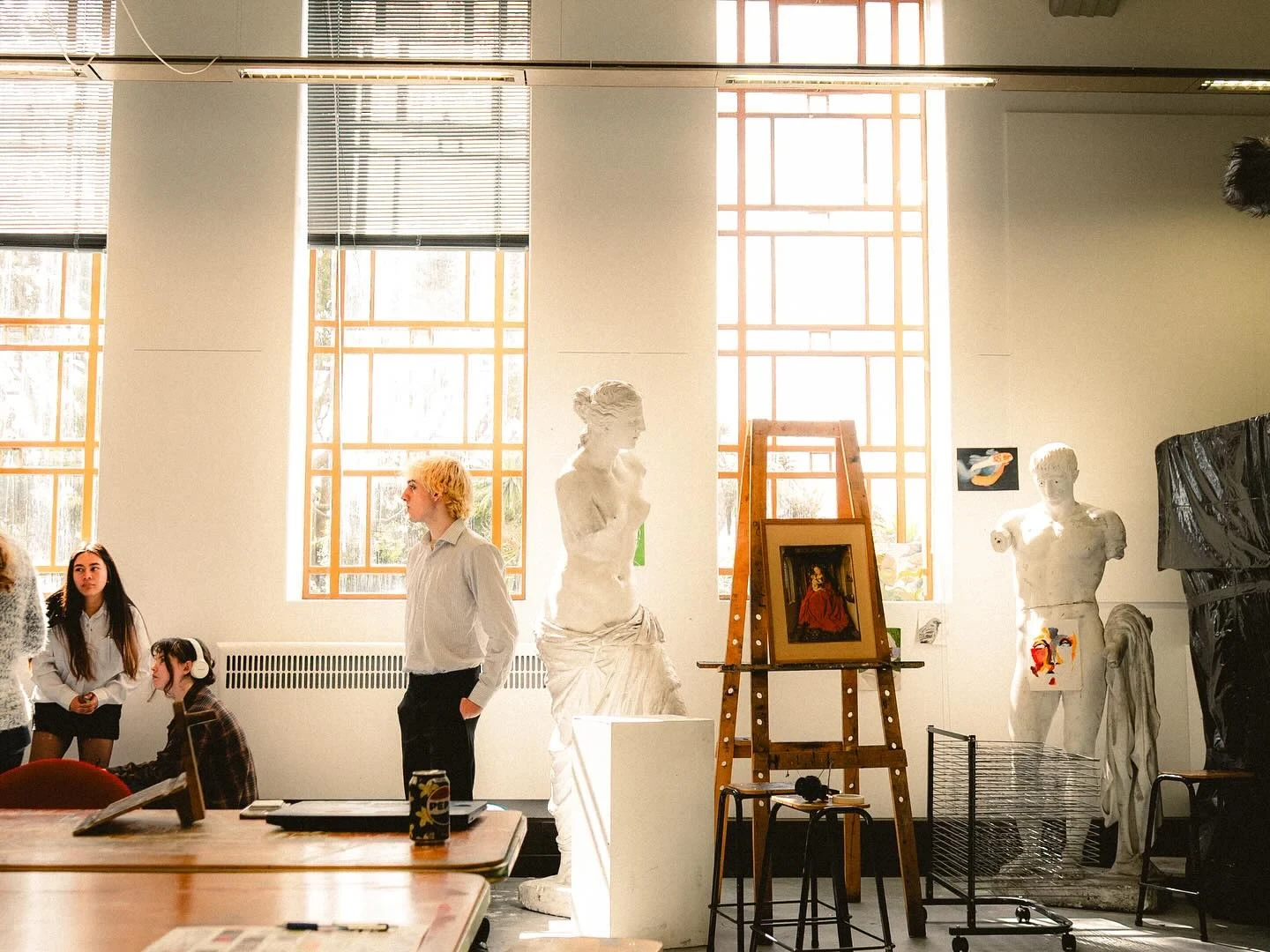
The production still from Mum I'm In Love With Wiremu Te Whenua is set in an art room full of Greek plaster casts, and it is the best photograph in the set. Three young people gather at the far left of the frame, two in conversation, one seated with headphones on. A fourth stands alone off-centre, hands in pockets, holding himself as still as the casts around him. The Aphrodite sits perfectly centred on her plinth, the formal anchor of the whole frame, with the standing figure placed just off her axis. A male torso stands centre-right, a colourful abstracted face taped over his groin, and a polythene-draped box of the same height is cut off by the right edge. The room is bathed in yellow light through three old steel-framed windows. An easel in the middle distance holds a small red-robed master painting, so the photograph contains a picture inside itself. A can of vanilla Pepsi sits on the table in the left foreground.
Everything about it looks staged and none of it was. The lone figure isn't posing for anything. He just happens to be standing that way, and Lucas has caught him in the half-second where he reads as a third figure in plaster rather than a person. The result has the composition of a seventeenth-century master: raking window light, a group at one edge, a solitary figure off-centre, an interior full of objects that tell you what work happens in the room. That near-symmetry, broken by one person, is what gives the frame its stillness, and it is the sort of thing you only get by waiting rather than arranging. It is not identifiably Wellington. It feels exactly like Wellington. The everyday drama of it, the painted face over the groin, the Pepsi can nobody moved.
Lucas photographs what is already there, in the light that happened to be available, and the result is less a record of places than of conditions: a good afternoon on the waterfront, hard sun on Boxing Day, a yellow room in the middle of a shoot day. The buildings and the people are almost incidental. What they are capturing is what it felt like to be in Wellington on that particular day, which is harder to photograph than a landmark and much harder to fake. They photograph the ordinary as though it were already historical.
When Robin Morrison published The South Island of New Zealand from the Road in 1981, the complaint was that he had left out everything the country pointed to as evidence of itself. He had gone looking for the rest of it instead: shopfronts, front yards, a man burning his rubbish, a café's vinegar bottles, the details he deliberately kept in frame. They are photographs you can get lost in. The instinct running through all of it was that an ordinary day was worth the film, and that the country was more accurately described by its furniture than by its landmarks. Lucas is working the same seam, forty-five years on and further north.
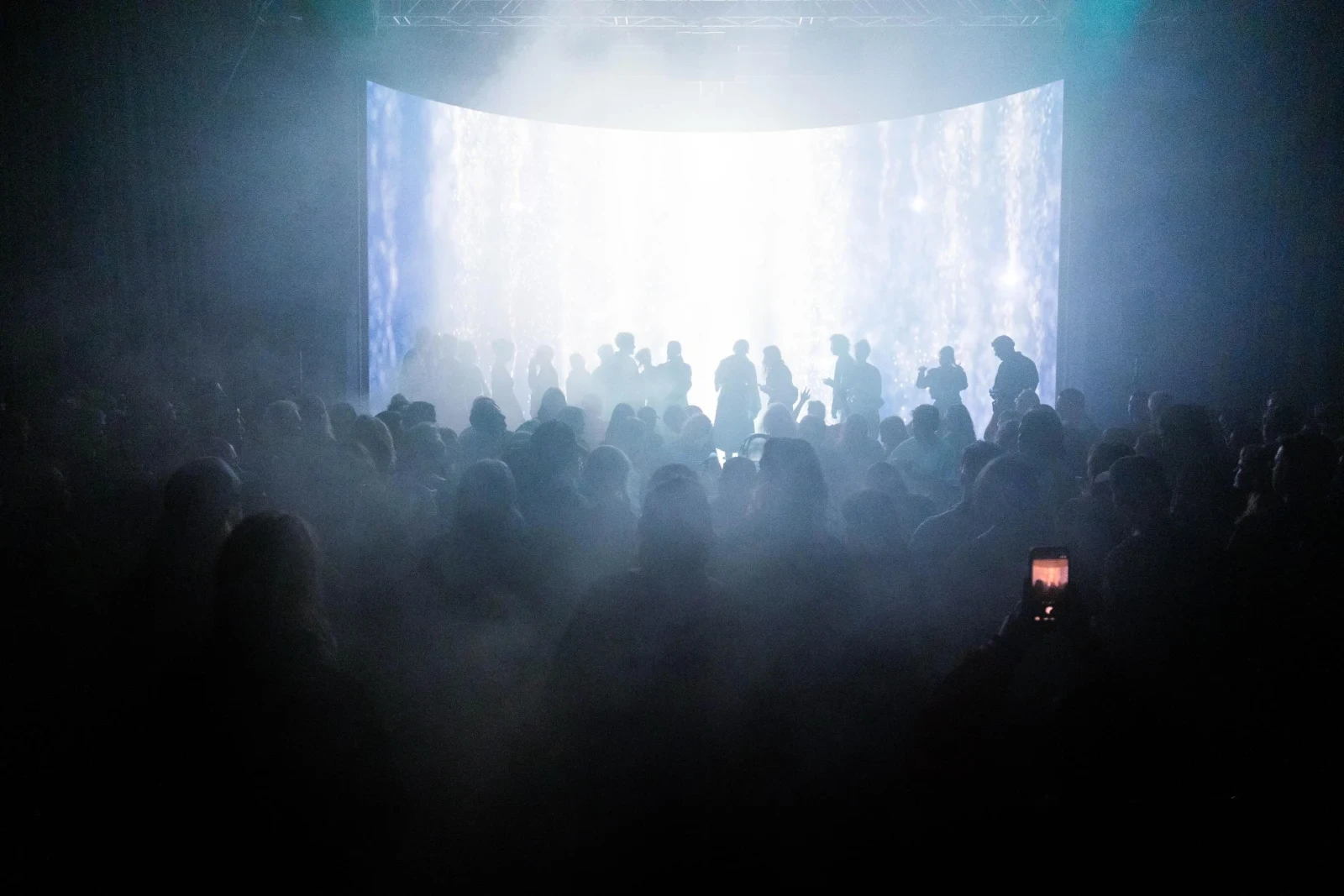
The concert photograph from PSYFI 2026: The Future Is Human is a gorgeous, ethereal thing, shot from the back of the room, well above head height, looking forward toward the performers. They are silhouettes against a glowing wall of smoke and texture; the crowd in between is reduced further still into the haze. There is exactly one phone screen glowing orange in the dark, where at most gigs now there would be a sea of them. The phone and the LED wall are the only things placing the image in this century. Strip them out and it could be any decade. It is a photograph of a room where almost everybody is watching the thing in front of them.
Lucas is shooting the room rather than the band. The performers are the furthest thing from the lens and the least resolved thing in the frame. What fills the picture is everything around them: the smoke, the light, the backs of several hundred heads. Asked what they notice from behind a camera that they never notice on stage, Lucas said: "the movement, energy, the space you're in, and even the pauses between songs. It makes you realise that no one remembers the wrong note you played, or even the name of the songs you played. What matters is how the performance made them feel after they've left at the end of the night." That is a musician's line, but they only arrived at it from behind a camera, watching audiences rather than being watched by them.
The band is Banjo Ben and the Breeze, a five-piece who busk on Cuba Street in the evenings and have played Newtown Festival, Cuba Dupa and the Fringe. They move between folk, rap, techno and pirate music, with comedy at the centre of it. "Humour reminds me to poke fun at the absurdity of life," Lucas says, "embracing the fact that life is, in itself, absurd." They see an opening: "New Zealand has always had a great tradition of dry, satirical comedy, and after the era of Flight of the Conchords, it feels like there's room to bring more of that playful energy back into music."
Create Wellington: Bookbinding Etc. (2026) is a promotional film for a traditional artisan bookbindery on Cuba Street, established in the 1980s and still doing hardcover case binding, thesis binding, hand repair and custom presentation boxes. It is a business feeling the effects of time in a technology-obsessed world. Lucas produced and directed; Moss Johnson shot it; Joseph Harrison recorded sound. What they made is not a showcase of a bookbinding business. It follows the people instead, and Tiffany Tucker, a second-year apprentice, carries it with a statement-of-fact humour that no brief could have specified.
What the film does is make you want to go there. Not to get anything bound, but to stand in a hole-in-the-wall workshop and smell the paper, watch Tiffany and Andrew work a case together, absorb the enthusiasm coming off them, maybe learn something. Most promotional films leave you aware that a business exists. This one leaves you wanting to be in the room, which is what every other photograph in their portfolio is doing, only with a client attached and a deadline on it.
Which brings it to room tone. It is a technical requirement, thirty seconds of a room doing nothing, recorded so an editor has something to lay under the cuts and stop the silences from sounding like faults. Every sound recordist asks for it and every crew resents standing still for it. Lucas offers it as advice for living: "Don't forget to also hold for room tone, it's important to leave yourself time to breathe and reflect." It is not a metaphor they reached for. It is a thing they actually have to do at the end of a shoot day.
There is a structural point buried in this. Patronage is built on a model of authorship the arts sector inherited from painting: one name, one work, one profile. Screen work does not behave that way. Five people recorded Shuriken and a sixth cut it. A client film has three names on it and a commissioning body's logo at the front. An artist who has spent years on crews has a portfolio that is genuinely shared, and no funding form in this country has a field for that. "The best work comes from trusting your crew, giving people space to contribute, and enjoying the process of making art together," Lucas says. "There's no point setting your sights on making a visually perfect film if your crew despises you." Their answer is to name everyone and keep going. The infrastructure should be able to do at least as much.
Selected Works:
PSYFI 2026: The Future Is Human (2026)
Photography
Mum I'm In Love With Wiremu Te Whenua (2026)
Production still, photography
Create Wellington: Bookbinding Etc. (2026)
Single-channel video, colour, sound, 4:35
Producer/Director Lucas Cantlon. Director of Photography Moss Johnson. Sound Joseph Harrison